Porte salvaspazio · FIP Porte dal 1969

Every hinged door takes up half a square meter of your room

An 80 cm leaf sweeps 0.50 m² of floor on which nothing can be placed. Here are the five ways to win it back — pivot-sliding, Fluid Motion folding, wall-mounted sliding, pocket, flush-to-wall — with how much space each one frees up and what work it involves.

Tell us about your opening →

0,50 m²80 cm
0.50 m²the floor area swept by an 80 cm leaf
5systems to win it back
180°the opening of the Fluid Motion folding door
1969made to measure in Capo d’Orlando

The problem, in numbers

It is not a question of bulk. It is a question of geometry.

In plan, a hinged door describes a quarter circle with a radius equal to the width of the leaf. The area is πL²/4: it grows with the square of the width, not in proportion. That is why a 90 cm door does not take up a little more than an 80 cm one: it takes up more than a quarter more.

0,50 m²80 cm

80 cm → 0.50 m²

of floor swept at every opening, where you cannot place a piece of furniture, a sanitary fixture or a chair.

    The values are calculated with the formula for the area of a circular sector (πL²/4) and with the geometric reductions of each mechanism: they can be checked with a calculator, they are not sales figures.

    The comparison

    Six floor plans, same 80 cm opening, same scale

    In orange, the area each system takes up: floor, wall or wall thickness. The gray hatching is always the swing of the hinged door, left there for comparison.

    0,50 m²80 cm
    Hinged doorThe reference: 0.50 m² swept
    0,25 m²80 cm
    Pivot-sliding0.25 m² swept · no
    0,13 m²80 cm
    Fluid Motion0.13 m² swept · no
    clear wall0 m² a pavimento80 cm
    Wall-mounted sliding door0 m² swept · wall-mounted track
    inside the wall0 m² a pavimento80 cm
    Pocket sliding door0 m² swept · pocket frame
    pocket frame0 m² e nessuna cornice80 cm
    Space-saving flush-to-wall0 m² swept · pocket frame and finishing
    what the system takes up the swing of the hinged door, for comparison masonry

    Find your solution

    Three questions, one system

    In practice the choice comes down to three constraints. Answer and we will tell you which system we would start from — and why.

    1. Can the masonry be altered?

    2. Next to the opening, is there a clear wall as wide as the door?

    3. What matters most?

    The five systems

    Ordered by how much work they need on your home

    It is not a price list: it is a scale. It starts with what fits in the existing opening and ends with what requires rebuilding the wall. You stop where you are willing to go. Each card also tells you when that system is not the right choice: that is the information you really need.

    Sistema 1 · nessuna opera muraria

    Pivot-sliding

    How it moves
    La porta ruota su un perno arretrato invece che sul filo del telaio: mentre si apre, metà anta entra nella stanza accanto e metà esce.
    How much it frees
    Dimezza l’area spazzata: da 0,50 a 0,25 m² su un’anta da 80 cm.
    When it makes sense
    Quando il vano è già fatto e non si vuole aprire un cantiere: stesso muro, stesso telaio, stessa maniglia, movimento diverso.
    When it doesn’t
    Quando serve il passaggio completamente libero: a porta aperta l’anta resta a cavallo del vano e toglie qualche centimetro di luce.

    Sistema 2 · nessuna opera muraria

    Fluid Motion

    How it moves
    L’anta è divisa in due pannelli che si piegano l’uno sull’altro e si accostano allo stipite. Il movimento è guidato da un binario superiore.
    How much it frees
    Riduce l’area spazzata a un quarto: da 0,50 a circa 0,13 m². Con l’apertura a 180° il pacchetto si appoggia al muro e il passaggio resta libero.
    When it makes sense
    Quando davanti alla porta c’è un mobile, un sanitario o un corridoio stretto, e non si può toccare la muratura.
    When it doesn’t
    Quando si cerca la superficie continua di una porta a un’anta sola: la linea di piega resta visibile anche a porta chiusa.

    Sistema 3 · binario a parete

    Wall-mounted sliding door

    How it moves
    L’anta esce dal vano e scorre davanti al muro, appesa a un binario fissato sopra l’architrave.
    How much it frees
    Azzera l’area spazzata a pavimento: 0 m².
    When it makes sense
    In ristrutturazione, quando c’è una parete libera accanto al vano e non si vuole demolire nulla.
    When it doesn’t
    Quando accanto al vano ci sono un interruttore, un termosifone o un mobile alto: serve una parete libera larga quanto l’anta.

    Sistema 4 · controtelaio nel muro

    Pocket sliding door

    How it moves
    L’anta entra dentro il muro, dentro un controtelaio annegato nella parete.
    How much it frees
    Azzera l’area spazzata e non occupa parete: 0 m² dentro e fuori.
    When it makes sense
    In nuova costruzione o quando la parete si sta comunque rifacendo: è il risultato più pulito che si possa ottenere.
    When it doesn’t
    Su un muro portante, su una parete piena di impianti, o quando il cantiere è già chiuso: il controtelaio va previsto prima dell’intonaco.

    Sistema 5 · controtelaio e finitura

    Space-saving flush-to-wall

    How it moves
    La porta è a filo della parete, senza coprifilo né cornice, e può essere abbinata a scorrimento o a rototraslazione.
    How much it frees
    Besides space, it gives you back the wall: the door stops being an element and becomes a surface.
    When it makes sense
    When the door has to disappear, not just take up less room: narrow corridors, fitted walls, prestige spaces.
    When it doesn’t
    Quando il budget o i tempi sono stretti: è la soluzione che richiede più precisione in cantiere e più coordinamento con chi fa i muri.

    In depth · system 1

    Pivot-sliding: it opens where a hinged door won’t fit

    It is the same door as ever, with the same solid leaf and the same handle. What changes is the point it turns around: no longer the hinge on the line of the jamb, but a set-back pin. As it opens, half of the leaf moves into the next room and half comes out — and the arc it sweeps on the floor is halved.

    0.50 → 0.25 m² swept area on an 80 cm opening, with the same wall and frame

    If you are coming from a hinged door, it is the shortest step: no building work, no visible track, no pocket frame. You replace what is there and gain half the swing.

    The set-back pin is also the system’s limit: with the leaf open, the panel stays across the opening and takes a few centimeters off the clear passage. If you need a completely clear passage, a different system is the right one.

    0,25 m²80 cm
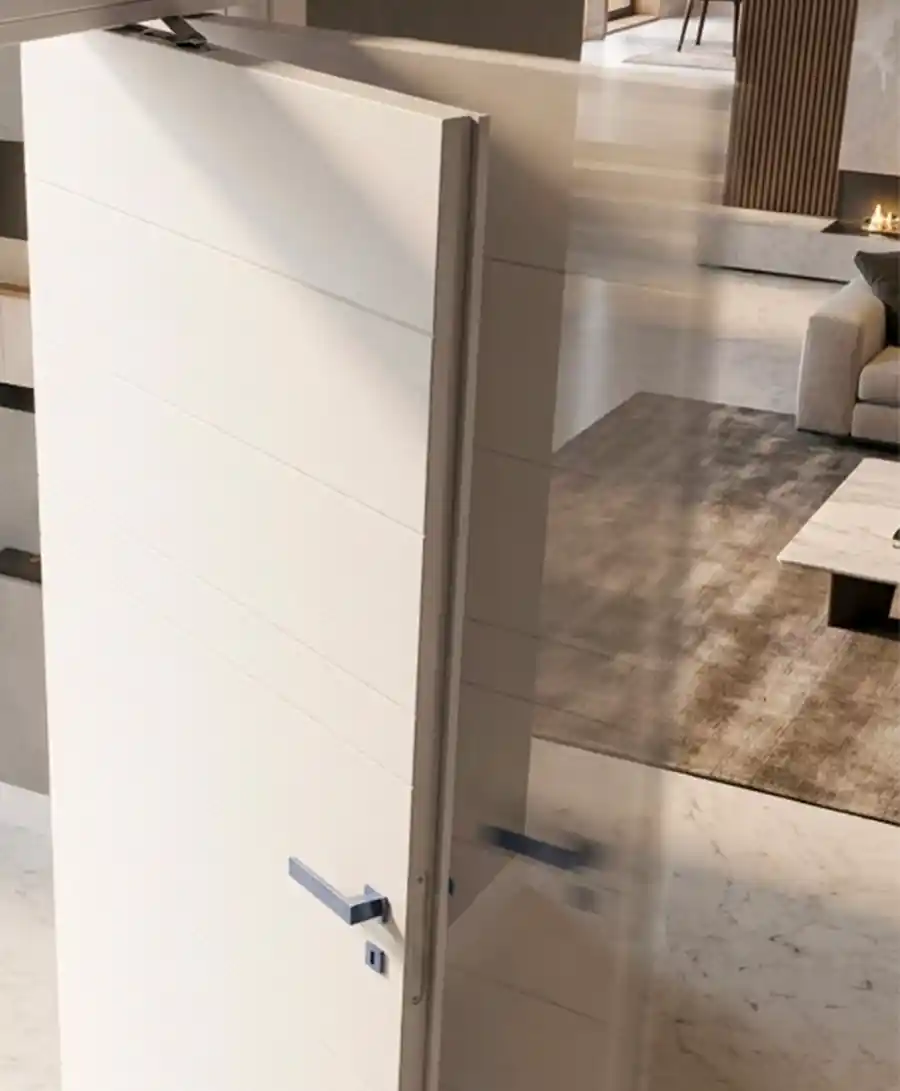
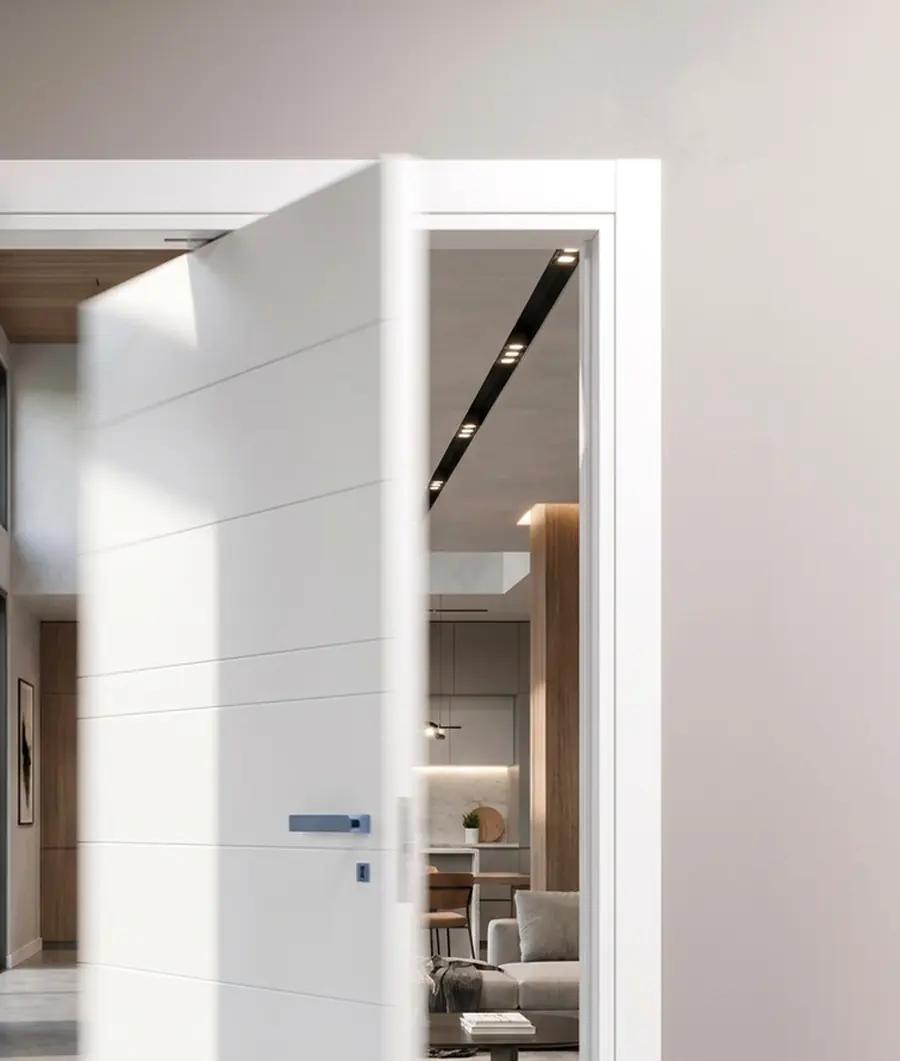
    White pivot-sliding door opening toward the living room
    The movement: the leaf opens while staying almost within the outline of the opening.
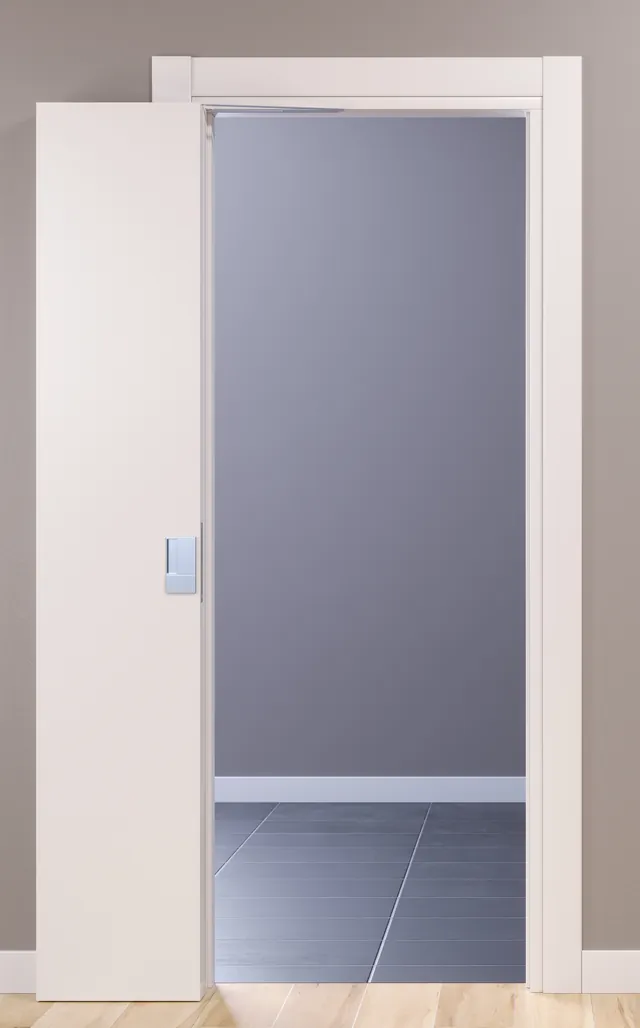
    Pivot-sliding door seen from above: the leaf pivots on its pin while straddling the opening
    From above it all becomes clear: half the leaf on this side, half on the other.

    In depth · system 2

    Fluid Motion: the leaf folds in two and stays within the opening

    The leaf is divided into two panels that fold onto each other and rest against the jamb, guided by an overhead track. The swept floor area drops to a quarter: from 0.50 to about 0.13 m².

    0.50 → 0.13 m² swept area on an 80 cm opening, without touching the masonry

    It closes perfectly against the stop. That is the difference between a door system and a hardware-store folding door: unlike ordinary folding doors, the Fluid Motion closes against the stop and ensures the same privacy as a traditional door.

    Zero building work. It fits in a standard opening without breaking walls, saving on labor costs compared with pocket sliding doors. That is the comparison that counts: the same result in plan, without building work.

    Fluid Motion folding door in walnut, open onto a walk-in closet

    See how it folds, in the finish you need

    Eleven finishes, three stages of opening. The scene is always the same: only the door changes.

    Fluid Motion folding door, preview of the selected finish

    Finish — White

    The finishes are the same as on other FIP doors: the folding door of the storage closet can be identical to the hinged door of the bedroom.

    The movement, for real

    The images show where the leaf ends up. The video shows how it gets there.

    It only starts when you open it: until then, no third-party scripts are loaded.

    90° or 180°: where the folded panels end up

    It is a choice made when ordering and depends on what is on the wall next to the opening.

    Fluid Motion folding door open at 90 degrees, folded stack edge-on beside the jamb
    90° — the folded panels stay edge-on next to the jamb: from outside you only see the thickness, and the adjacent wall stays clear.
    Fluid Motion folding door open at 180 degrees, folded stack lying flat against the wall
    180° — the folded panels keep turning and lie flat against the wall: the clear passage stays completely free.

    Linea Domus

    The Linea Domus, and the systems that recover space

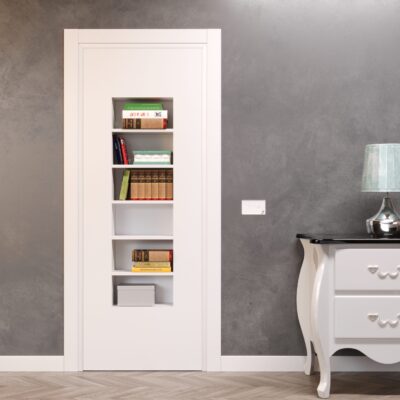
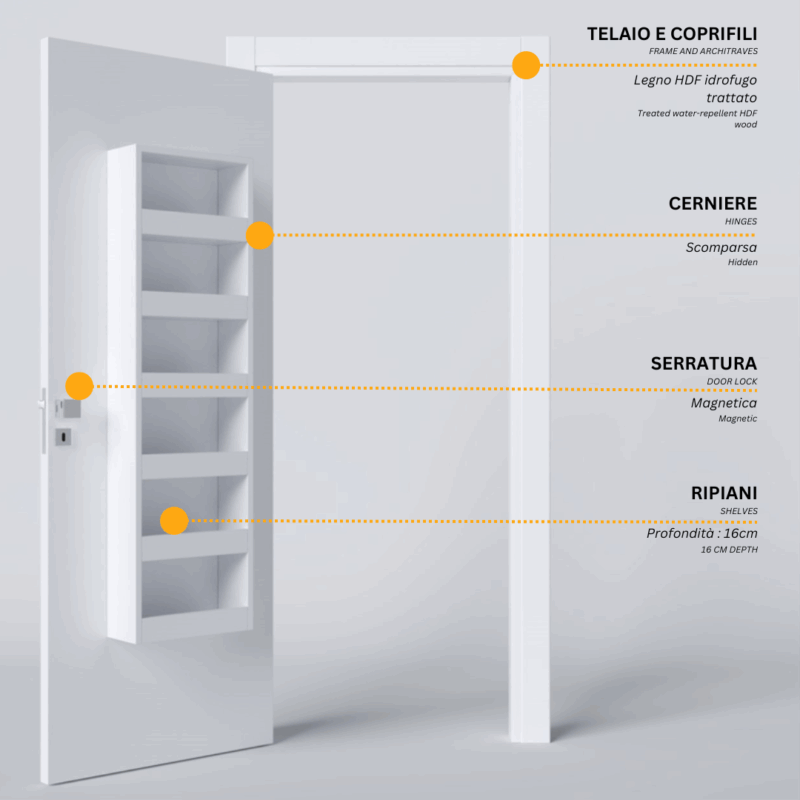
    The other five systems give back floor space by changing the way the door opens. The Linea Domus does something different: it uses the thickness of the leaf for storage. The All-purpose and the Library are ordinary hinged doors on one side and open shelving on the other.

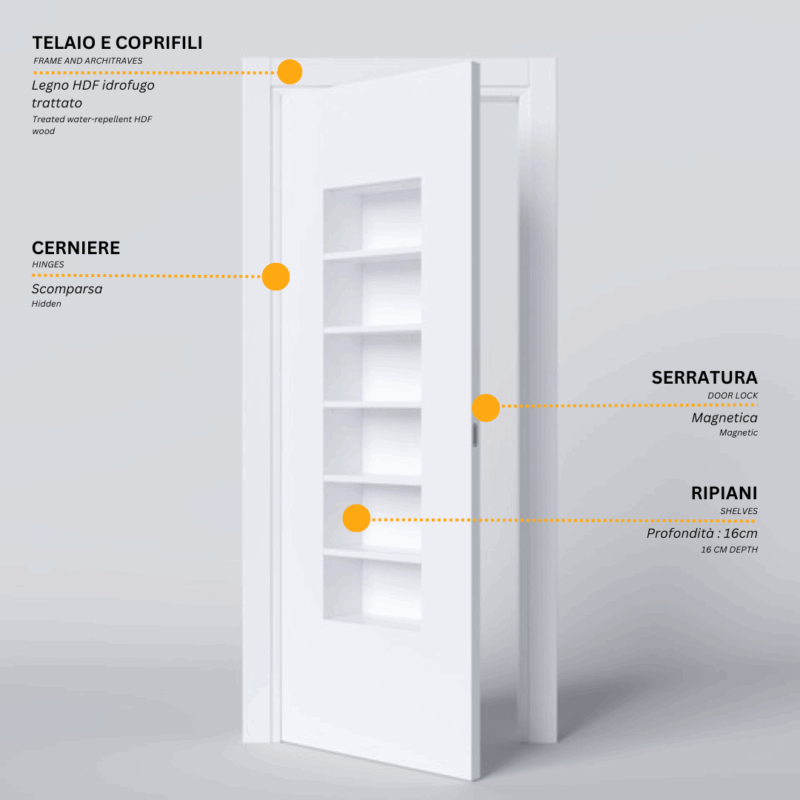
    The internal structure is made of strips of selected fir, from certified wood, processed entirely in Italy. The frame and the trims, In treated water-repellent HDF, support the leaf and resist moisture.

    FIP Porte space-saving door, Porta-Tutto model, closed
    All-purpose
    FIP Porte space-saving door, Libreria model, closed
    Library

    The functionality is at the heart of the Linea Domus: as well as enhancing the look of interiors, these space-saving doors are designed to free up the quarter circle a hinged door takes up in front of it, without giving up practicality and everyday comfort. The concealed hinges and the magnetic closure fitted as standard ensure smooth, silent and effortless opening and closing.

    For a made-to-measure customization, you can choose the lacquer color and the hinge finish, so that the door matches the rest of the room.

    It is the right solution in a storage closet, a narrow entrance or a child’s bedroom: it doesn’t gain square meters of floor, it gains linear meters of shelving.

    Features

    Features sheet of the FIP Porte space-saving door, Libreria model
    Features sheet of the FIP Porte space-saving door, Porta-Tutto model

    Buy online →

    Questions

    The questions we are always asked

    Which doors save space?

    Le porte scorrevoli (esterno muro o a scomparsa), a libro e rototraslanti: eliminano l’ingombro dell’apertura a battente.

    How much space do you gain with a space-saving door?

    Dipende dal sistema: la rototraslante dimezza l’area spazzata (da 0,50 a 0,25 m² su un vano da 80 cm), la porta a libro la porta a circa un quarto (0,13 m²), le scorrevoli e il filomuro la azzerano.

    How much space does a hinged door really take up?

    Un’anta a battente spazza in pianta un quarto di cerchio di raggio pari alla sua larghezza. Per una porta da 80 cm sono 0,50 m² di pavimento, per una da 90 cm sono 0,64 m². È area su cui non si può appoggiare nulla: né un mobile, né un sanitario, né una sedia.

    Che differenza c’è fra una porta rototraslante e una porta a libro?

    La rototraslante è un’anta sola che ruota su un perno arretrato: metà entra e metà esce dal vano, e l’area spazzata si dimezza. La porta a libro è divisa in due pannelli che si piegano l’uno sull’altro e si accostano allo stipite: l’area spazzata scende a circa un quarto. La rototraslante mantiene la superficie continua dell’anta, la porta a libro libera più pavimento.

    Does the Fluid Motion folding door close like a normal door?

    Yes. Unlike standard bi-fold doors, the Fluid Motion closes with a perfect flush fit and guarantees the same privacy as a traditional door. It is the difference between a door system and a folding accessory.

    Do you need to break the wall to install a folding door?

    No. The Fluid Motion fits in a standard opening, without building work, and this sets it apart from the pocket sliding door, which requires a pocket frame embedded in the wall and therefore work on the wall.

    Pocket sliding or wall-mounted sliding: which is better?

    The recessed installation disappears into the wall and provides the cleanest look, but it requires the telaio and must be planned before the plastering is done. The external wall-mounted unit is installed after the construction site is closed, but it requires a clear wall space as wide as the leaf, free of switches, radiators, or tall furniture.

    Che cosa vuol dire apertura a 90° e a 180° su una porta a libro?

    At 90°, the folded panel remains flush against the jamb: from the outside, only its thickness is visible. At 180°, the panel continues to rotate and lies flat against the wall, clearing the entire opening. The choice depends on what is on the wall next to the opening.

    Are FIP space-saving doors made to measure?

    Yes. All systems are custom-made at the Capo d’Orlando plant, with the same finishes as the other interior doors: the salvaspazio bathroom door can be identical to the bedroom hinged door.

    How do I know which system I need?

    Tre domande bastano quasi sempre: si può toccare il muro, c’è una parete libera accanto al vano, e che cosa conta di più fra guadagnare pavimento e non vedere la porta. Il percorso guidato in questa pagina le fa e propone un sistema; il preventivo parte da lì.

    FIP Porte

    The Company

    FIP Porte is an Italian company that makes custom doors in Capo d'Orlando, in Sicily, since 1969. Every line has its own standard sizes: outside those, we work to the opening you measure.

    Our history →

    Our Headquarters

    Via Consolare Antica, 402
    Capo d’Orlando (ME), Italy

    Phone

    +39 0941 901172

    Email

    info@fipporte.com

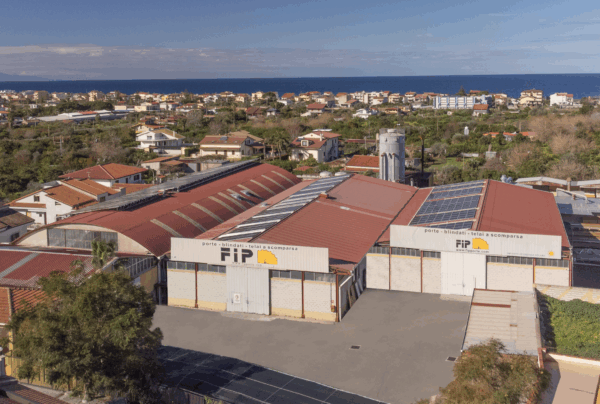
    The FIP Porte factory in Capo d’Orlando

    Want to find out more about our production?

    The catalog contains all the lines with their standard sizes. If your opening is a non-standard size, send us the measurements.

    Contact us   View the catalogue