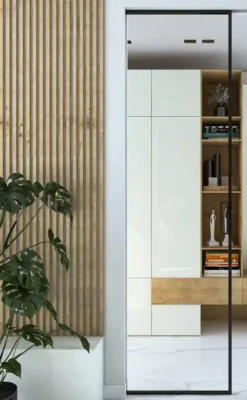
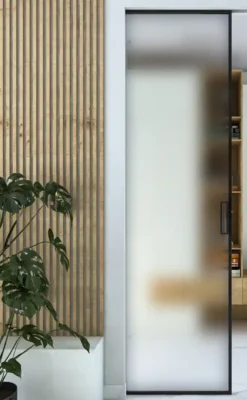
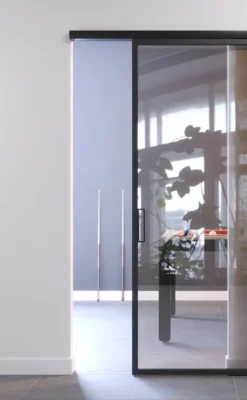
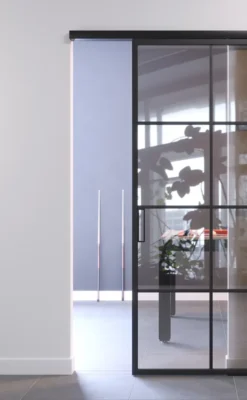
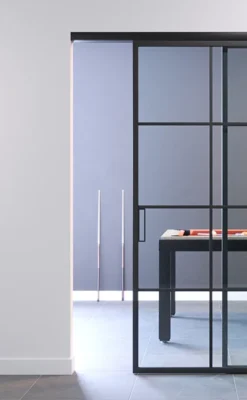
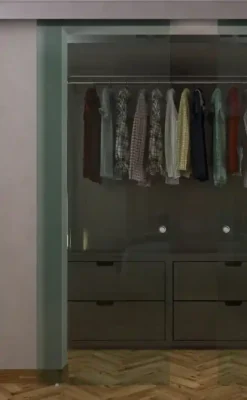
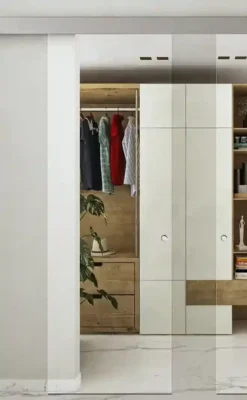
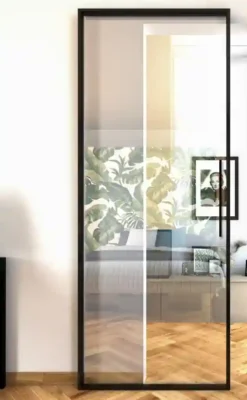
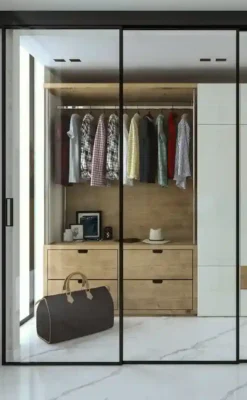
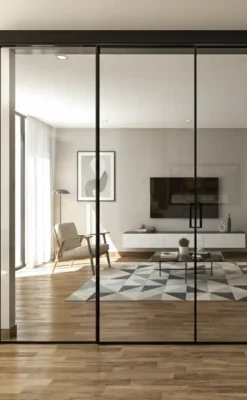
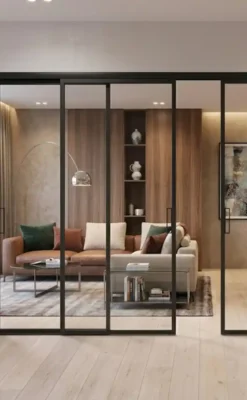
At a glance, the track remains above the leaf. This is the system used for the single- and double-panel sliding doors and the partition walls models in the catalogue; in three- and four-panel systems, it is the pull-type version.
6 solutions in the catalogue
FIP Porte · Custom-made since 1969
Framed doors: glass inside a frame
The profiled leaf features a perimeter frame that surrounds the glass and defines its design. Fourteen options, including casement, pivot, sliding, and partition walls styles, each with its own selection of glass types. All are custom-made to fit the opening.
Request a custom quote → Go to the catalogueThe starting point
What's the difference compared to a glass door without frame?
The difference isn't the glass—it's the frame. In the leaf profile, a perimeter frame runs around the glass, holding it in place and defining the door. In the Full Glass version, the frame of the leaf is absent, leaving only the glass panel.
It runs along the entire perimeter of the leaf. It is made of wood or aluminum, both of which can be customized in terms of finish to match the furnishings. In the ’paned« versions, the frames also extend inside the glass and divide it into sections.
Otto tipi, dal trasparente allo specchio: cambiano quanta luce passa e quanto si vede.
There are no standard sizes. The width and height are measured on the opening, and the frame is built around those dimensions. For the estimate, we need the dimensions of the opening and details about what’s on the adjacent wall.
If instead you were looking for the frameless door, with the glass reaching all the way to the edge, that is the Full Glass. Go to Full Glass →
How do you want to open it?
Movement is chosen before the drawing
It's not a matter of taste: it depends on how much space you have in front of the opening and what's on the wall next to it. Make your selection here, and the catalogue will filter itself.
Choose the glass
Eight panes of glass: light passes through, the view remains
The leaf itself changes completely depending on the glass used. Six of the eight options are available for almost all configurations, so the choice of door and the choice of glass are made at two different stages. All the glass used is safety glass—either tempered or laminated.
Total visual continuity. All the light passes through and the two rooms remain a single entity: it is the glass for dividing without closing.
out of 12 solutions
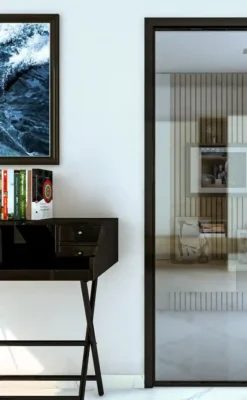
It reflects the light back like a dark mirror without completely blocking the view. The effect changes with the time of day and the side from which it is viewed.
out of 12 solutions
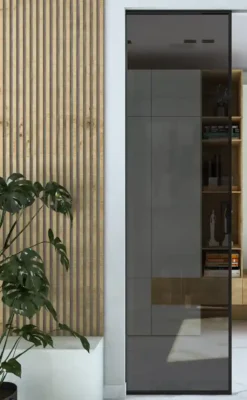
The tinted transparent. Behind the leaf, you can still read everything, but with less light and much greater visual impact.
across all solutions
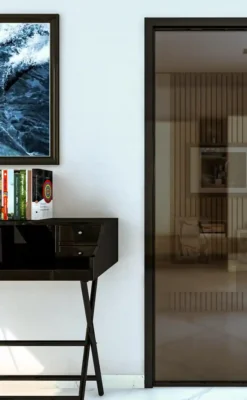
The warm version of the smoked look: the hue shifts toward amber and the woods behind the glass light up.
across all solutions
It lets in light and blocks the view: silhouettes are visible, not details. It is the choice when you need privacy without sacrificing light.
across all solutions
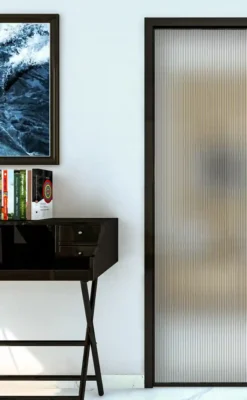
Vertically ribbed glass. The ridges break the image into thin strips: all the light passes through, what is behind barely at all.
out of 13 solutions
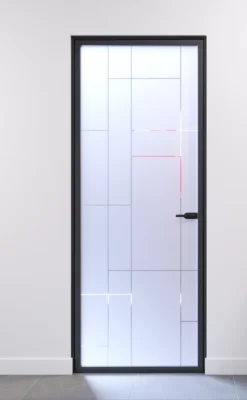
The glass is sandblasted to create a specific pattern. In the catalogue, it’s listed for the leaf casement window, but the pattern can be customized.
on 1 solution
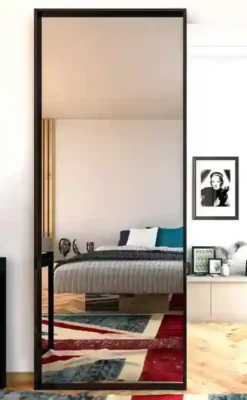
No transparency: the leaf becomes a full-length mirror. In the catalogue, it’s shown on a sliding track with the Magical rail system.
on 1 solutionOnly for sliding doors
Two tracks, and it shows
If the leaf is running, the tracks are the second choice to make. What you see above the door changes, and it’s not a minor detail: it’s at eye level for anyone entering.
The track is concealed: you can't see anything above the door. It's the same system as the Frames line, and it's the only one in the catalogue that features the mirrored leaf.
2 solutions in the catalogueWhere does it work
Four rooms where glass solves something
It is not the door for every room: it is the door for rooms that have a light or space problem. These are the four most frequent ones.
Complete catalogue
14 solutions, 81 combinations
Each panel is a solution, not a variation: the glass is changed using the labels under the photograph, without reloading anything. Filter by what you already know and forget about the rest.
No solution with this combination.
In-depth analysis
Profiled doors: the frame is the design
A glass door solves a problem that no solid door can solve: dividing two spaces while allowing natural light to pass through. The leaf profile does this by adding a frame, and that frame is half the design.
Why the frame changes everything
The frame perimeter frame gives the door a clean outline and sets it apart from the wall: it appears as an object, not as an opening. In the versions with panels, the frames extend into the glass and divide it into sections, giving it a more structured look. That’s why you’ll find the same solutions in both versions in the catalogue: they aren’t two different products— they’re two designs of the same door.
Coordinate, do not match
Lo stesso vetro e la stessa finitura di telaio possono tornare sulla porta a battente della camera e sulla parete divisoria del soggiorno: è l’unico modo perché una casa sembri progettata invece che comprata a pezzi. Guarda le available finishes.
The right glass for every room
La scelta del vetro decide quanta luce passa e quanta privacy resta. Il trasparente mantiene la continuità visiva totale; il satinato e il plissé lasciano passare la luce filtrando la vista, ed è quello che serve in bagno e in camera; il riflettente, il fumé e il bronzo aggiungono profondità e schermano; il vetro a disegno diventa un elemento d’arredo.
Beyond the single door
The same cabinet doors, placed in a row on a track, become a partition wall: the solution to separate kitchen and living room or create a home office. For professional environments, there are technical glass doors.
Measurements are always custom-made for the opening: there are no standard sizes. To get a quote, we need the width and height of the opening and what’s on the adjacent wall.
Who has already bought
The best of Italian craftsmanship in Sicily!I had the pleasure of being looked after by Marco at FIP Porte and I was struck by his extraordinary courtesy and helpfulness. From the very first conversation he was attentive, patient and always ready to answer every question of mine with competence and kindness.
Beautiful doorsBeautiful doors, exactly as described. Kind and helpful staff! I ordered two doors from Valle d’Aosta, there was a small hitch but the staff sorted everything out. Very satisfied.
A thoroughly positive experienceI had the entrance door and the interior doors fitted at home, and I did not expect that after two weeks the owner (Daniele, extremely friendly) would call to tell me the doors were ready to be fitted. As soon as they went in I could see how beautiful they were.
If this is not what you are looking for
Three close solutions
The profiled leaf isn't always the right solution: shown here are the three product families that solve the same problem in a different way.
Questions
Frequently asked questions about profiled doors
What is a profiled leaf?
It is a glass leaf with a perimeter frame—made of wood or aluminum—that frames the glass and defines its design. It is available in hinged, pivot, and sliding styles, as well as in multi-panel configurations for partition walls models.
Are interior glass doors safe?
Yes, they are made of tempered or laminated safety glass, which is impact-resistant and complies with regulations.
Can glass doors be non-transparent?
Certo: oltre al trasparente ci sono il riflettente, il fumé, il bronzo, il satinato, il plissé, il vetro a disegno e lo specchio. Sono otto, e cambiano quanta luce passa e quanto si vede.
Do glass doors insulate against noise?
They reduce noise, but to a lesser extent than a solid door; for greater insulation, laminated glass is recommended.
What types of frames are available for FIP glass doors?
Wooden or aluminum frames, both customizable in finishes to match the furniture.
What is the difference between the leaf Profiled model and the Full Glass model?
The leaf model features a perimeter frame around the glass; in the Full Glass model, the frame frame of the leaf is omitted, leaving only the glass. The door design changes, but the type of glass remains the same: the available openings are identical.
What does «con riquadri» mean?
The frames don't just run along the perimeter—they also extend into the leaf and divide the glass into sections. This is a design choice: the catalogue features the same solutions in both versions—with and without the frames.
What is the difference between Compact binary and Magical binary?
The Compact remains visible above the leaf; the Magical is concealed and cannot be seen above the door. The choice depends on what is above the opening and the desired effect.
Are the shaped doors made to measure?
Yes. The width and height are based on the opening, and the frame is built around those measurements: there are no standard sizes.
Can you have the same glass on all the doors in the house?
Yes, and that’s why the same glass appears in almost every design in the catalogue: the bedroom’s hinged door and the living room’s partition wall can both feature the same glass and the same frame finish.
Quote
Tell us the opening, and we'll tell you what's in it
You don't need to have made a choice: just give us three pieces of information, and we'll tell you which solutions fit within your opening budget and which don't—even before we talk about price.